pacman::p_load(tidyverse, dplyr, ggplot2,ggstatsplot, performance, plotly, crosstalk, DT, ggdist, gganimate,FunnelPlotR, knitr)Take-home_Ex03
In this take-home exercise, we will look into the patterns of the resale prices of public housing property by residential towns and estates in Singapore.
1. R Preparation
Install and launching R packages
The code chunk below uses p_load() of pacman package to check if the necessary packages are installed. If they are, they will be launched into R.
Importing the data
The code chunk below uses read_csv function to reads the CSV file into a data frame named property_data.
The dataset: Resale flat princes based on registration date from Jan-2017 onwards.
Data is from Data.gov.sg.
property_data <- read_csv("data/resale-flat-prices-based-on-registration-date-from-jan-2017-onwards.csv")Data Exploration and Analytical Visualisation Selection
Firstly, we will need to understand the data attributes in the selected data set:
| Data Attributes | Data Type |
|---|---|
| month | datetime |
| town | text |
| flat type | text |
| block | text |
| street name | text |
| storey range | text |
| floor area sqm | numeric |
| flat model | text |
| lease commence date | datetime |
| remaining lease | text |
| resale price | numeric |
We can also run summary() to get a glance of the data set.
summary(property_data) month town flat_type block
Length:146429 Length:146429 Length:146429 Length:146429
Class :character Class :character Class :character Class :character
Mode :character Mode :character Mode :character Mode :character
street_name storey_range floor_area_sqm flat_model
Length:146429 Length:146429 Min. : 31.00 Length:146429
Class :character Class :character 1st Qu.: 82.00 Class :character
Mode :character Mode :character Median : 94.00 Mode :character
Mean : 97.61
3rd Qu.:113.00
Max. :249.00
lease_commence_date remaining_lease resale_price
Min. :1966 Length:146429 Min. : 140000
1st Qu.:1985 Class :character 1st Qu.: 358000
Median :1996 Mode :character Median : 448000
Mean :1996 Mean : 478124
3rd Qu.:2007 3rd Qu.: 565000
Max. :2019 Max. :1418000 In this take-home exercise, we will focus on 3, 4, 5 Room HDB in the study period of 2022.
In order to explore the patterns of the resale prices of public housing property by residential towns and estates in Singapore, there are a few possible affecting factors we can analyse, namely: town, flat type, floor area sqm, flat model and lease commence date/ remaining lease.
Hence from the above, some consideration of the visualization analysis are:
- Look into the resale price by 2 different flat midels. We choose standard and DBSS in this exercise. We can build a Two-Sample-Mean-Test to do the comparison.
- Then we can focus on standard HDB flat model to do a fair comparison on how other factors affect the resale price. We firstly look at Resale price by town as location is one of the most important factor. We will firstly create a bar chart to show average resale price by town. Then we will do an uncertainty of point estimate to understand the reliability and accuracy of the estimates generated.
- Then we start to explore resale price by floor area sqm. We use a scatter plot to visualise the pattern distribution first. Then we conduct a significant test of correlation to understand on their correlation relationship.
- As there are a few possible affecting factors, namely: town, flat type, floor area sqm and lease commence date/ remaining lease, we will run a multiple regression model with these factors against resale price to see which factor(s) has/ have higher correlation.
- Then we look at flat type (3, 4 or 5 Room HDB) and resale price by using box plot
- Lastly we build a heatmap
Analytical Visualisation Preparation
Data preparation
We use filter function from dplyr() package to extract rows that satisfy the given criteria.
extracts rows where the first four characters of “month” column are “2022” to make 2022 as the study period
extract “flat_type” column whereby is “3 Room” ,“4 Room” or “5 Room”.
extract “flat_model” column to be “Standard” or “DBSS” HDB.
The resulting filtered data is stored in a new data frame named filtered_data
filtered_data <- property_data %>%
  filter(substr(month, 1, 4) == "2022", flat_type %in% c("3 ROOM", "4 ROOM","5 ROOM"), flat_model %in% c("Standard","DBSS") )
As the flat_type is in text format, we extract numeric part of flat_type column using mutate() in order to use it for chart plotting.
filtered_data <- filtered_data %>% mutate(flat_type_num = str_extract(flat_type, "\\d+"))Flat Model (Standard VS DBSS) Resale Price Comparison with Two-sample Mean Test
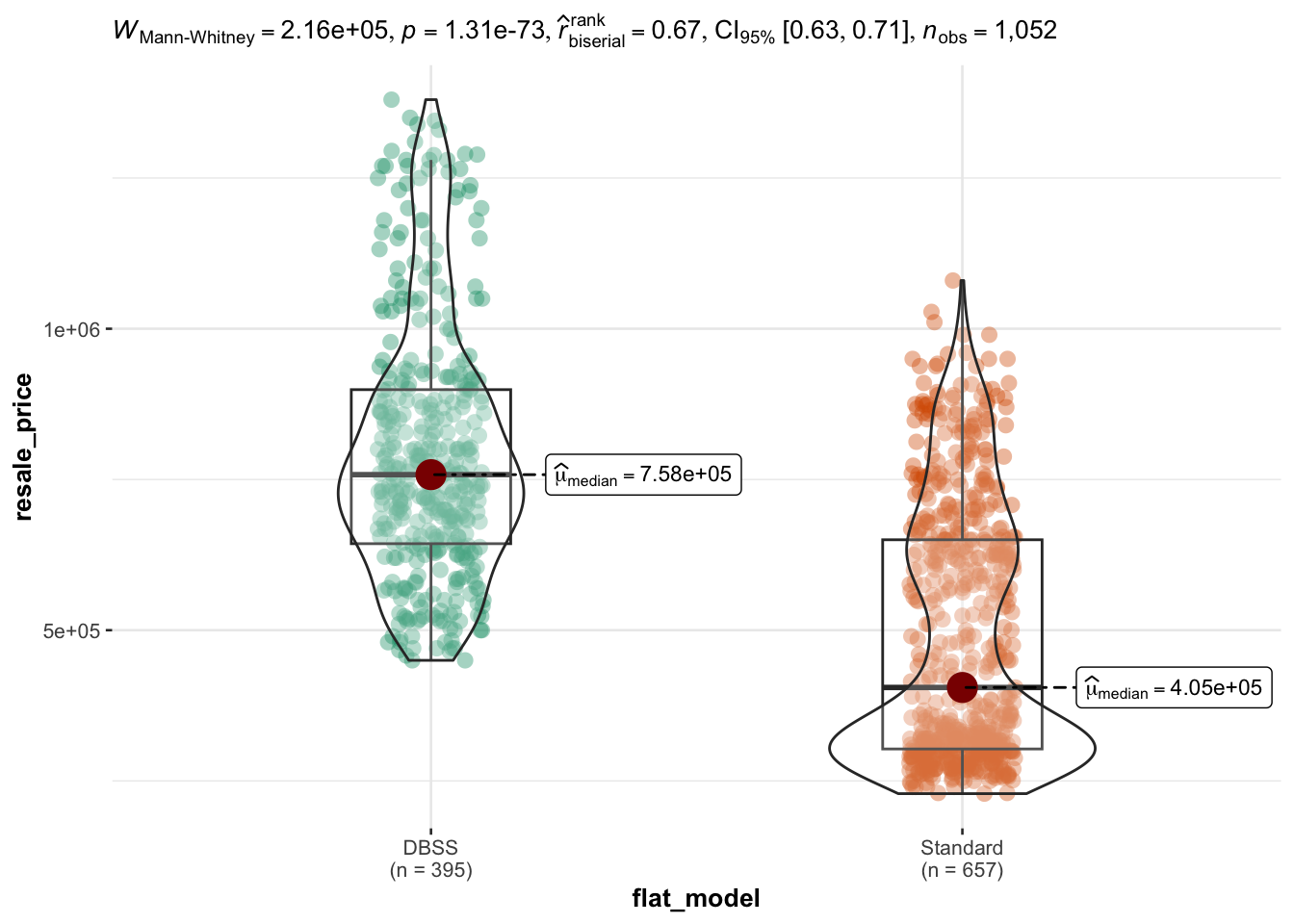
As DBSS flats are built by private developers with each development characterised by unique external features, it is usually a preferred choice for potential buyers. Hence we would like to compare it’s resale price compared to standard HDB via two-sample mean test, and understand roughly how much premium is required for DBSS flat.
In the code chunk below, ggbetweenstats() is used to build a visual for two-sample mean test of resale price by flat model, namely DBSS and Standard.
ggbetweenstats(
  data = filtered_data,
  x = flat_model,
  y = resale_price,
  type = "np",
  messages = FALSE
)
Pattern Observation
We can observe from the above chart, DBSS flat resale price mean is at 758K, compared to that of standard HDB at 405K. There are fewer transactions of DBSS in 2022 (in total 395) compared to standard (in total 657). This could be due to more standard HDB flats in the market.
Resale Price by Town
As now we know that there is a significant difference in resale price between DBSS and Standard HDB, we will narrow down the scope to Standard flat model in order to reduce the number of variables. This will help us to understand the relationship between resale price with other affecting factors, such as town, sqm and flat type better.
Hence, we create another tibble data, standard_data for Standard HDB flat model.
standard_data <- filtered_data %>%
  filter(flat_model == ("Standard") )
Average Resale Price by Town
Use a geom_bar() in ggplot() package to plot a simple bar chart to compare the average resale price of different towns.
Use plotly() to add interactivity to show town name and average resale price of the selected town.
bar_chart <- ggplot(standard_data, aes(x = town, y = resale_price)) +
  geom_bar(stat = "summary", fun = "mean") +
  labs(x = "Town", y = "Average Resale Price") +
  theme(axis.text.x=element_blank(),
        axis.ticks.x=element_blank()) +
  ggtitle("Average Resale Price by Town")

bar_chart <- ggplotly(bar_chart, tooltip = c("town", "resale_price"))

bar_chart
Pattern Observation
From the bar chart, we can observe that the top 3 town based on average resale price are: Bukit Timah, Marine Parade and Clementi. The bottom 3 are: Geylang, Toa Payoh and Kallang/ Whampoa.
Before jumping into conclusion, it is also important to conduct a Uncertainty Test for resale price.
Visualizing the Uncertainty of Point Estimates
We create another tibble data, my_sum, to calculate the mean, standard deviation and standard error of resale price in standard_data.
my_sum <- standard_data %>%
  group_by(town) %>%
  summarise(
    n=n(),
    mean=mean(resale_price),
    sd=sd(resale_price)
    ) %>%
  mutate(se=sd/sqrt(n-1))
Then we use geom_errorbar() function from ggplot() package. We are able to visualise clearly the resale price standard error and the mean resale price indicated by a red dot for different town.
Then convert it to a plotly object using ggplotly() function.
errorbar_plot <- ggplot(my_sum) +
  geom_errorbar(
    aes(x=town,
        ymin=mean-se,
        ymax=mean+se)) +
  xlab("town") +
  ylab("resale price standard error with mean") +
  theme(axis.title.x=element_blank(),
        axis.text.x=element_blank(),
        axis.ticks.x=element_blank()) +
    geom_point(aes
           (x=town,
            y=mean),
           stat="identity",
           color="red",
           size = 0.5,
           alpha=1) +
  facet_wrap(~ town) +
  ggtitle("Standard Error of Mean Resale Price by Town")

p_interactive <- ggplotly(errorbar_plot)

p_interactive
Pattern Observation
The above uncertainty of point estimates trellis chart show the range of resale price that the estimate is likely to fall within, with 95% level of confidence.
We can see that the variability in resale price in Clementi is the largest. Whereas in towns such as Bedok, Hougang, Jurong West and Woodlands, there is not much variability in the mean resale price. This will lead to easier price prediction in these regions.
Resale Price by Floor Area in Different Towns
After understanding the differences in average resale prices in various towns, we now add floor area (sqm) into consideration. We look at individual transaction resale price rather than average for this case.
We use geom_point() from ggplot2 package to create a scatter plot to explore the relationship between resale price and floor area, with different colors or shapes representing different towns or estates.
scatter_plot <- ggplot(standard_data, aes(x = floor_area_sqm, y = resale_price, color = town)) +
  geom_point() +
  labs(x = "Floor Area (sqm)", y = "Resale Price", color = "Town") +
  ggtitle("Scatter plot of Resale Price vs. Floor Area by Town")

scatter_plot <- ggplotly(scatter_plot, tooltip = c("town","floor_area_sqm", "resale_price"))

scatter_plot
Pattern Observation
We observe that even though Bukit Timah has the highest average resale price, the top 3 resale price transactions are for HDB in Maria Parade.
The common assumption is the bigger the floor area, the higher the resale price. In order to understand more about the correlation between floor area sqm and resale price, we will run a Significant Test of Correlation.
Significant Test of Correlation
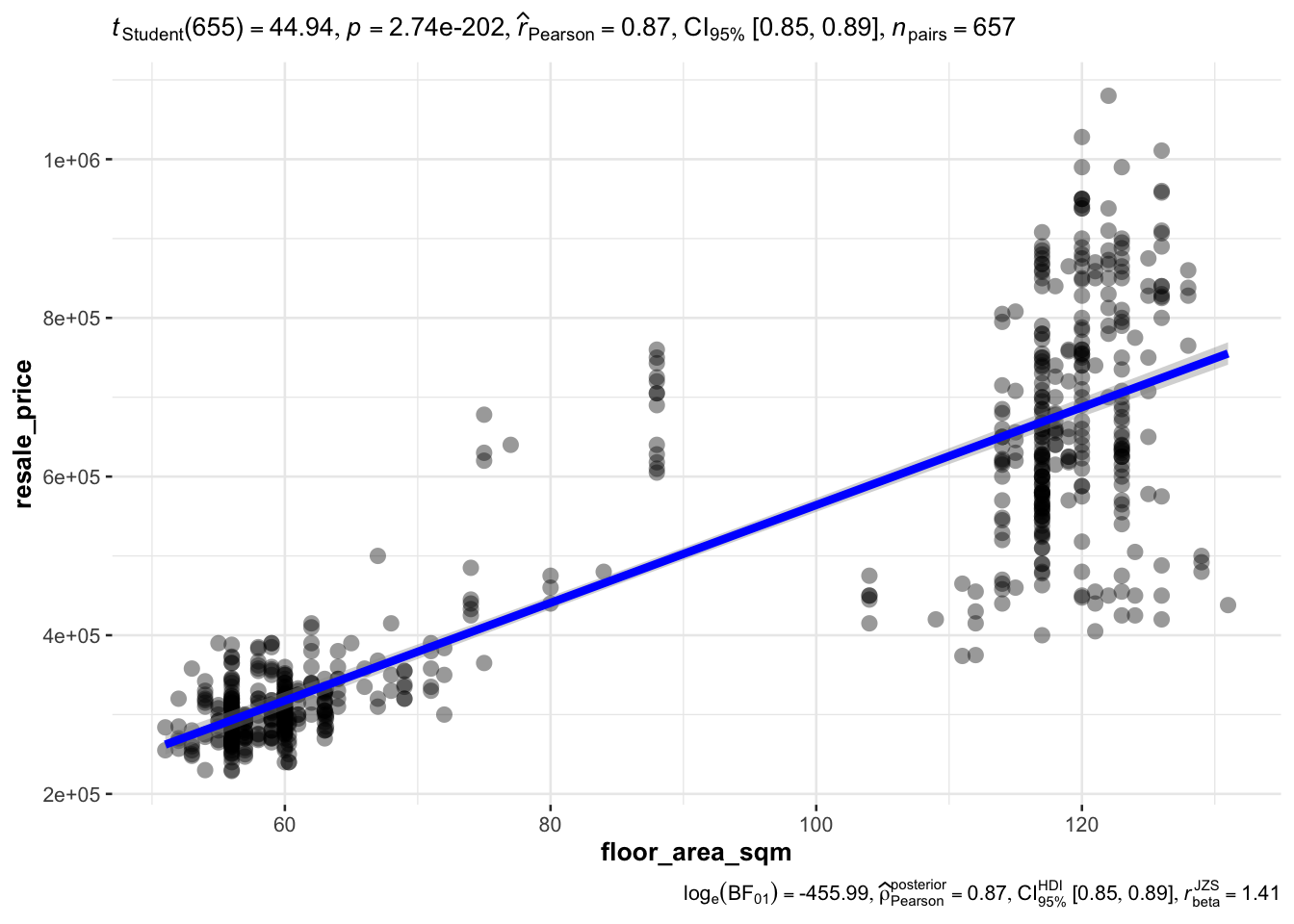
In the code chunk below, ggscatterstats() is used to build a visual for Significant Test of Correlation between floor area (sqm) and resale price (S$).
ggscatterstats(
  data = standard_data,
  x = floor_area_sqm,
  y = resale_price,
  marginal = FALSE,
  )
Pattern Observation
From the above t-test with sample size of 657 transactions, we see a linear correlation between floor area (sqm) VS resale price. The correlation coefficient, r(pearson) = 0.87, indicating a positive linear relationship between floor area (sqm) and resale price. The small p value indicates statistic significance.
However, there are still outliers which fall far away from the linear regression line.
Hence we will continue the exploration by looking into Multiple regression model to consider other factors.
Multiple Regression Model
We will add in lease commence date and flat type into the model and build a multiple regression model. This is to analyse how these other factors affecting the resale price besides floor area.
model <- lm(resale_price ~ floor_area_sqm + lease_commence_date + flat_type_num, data = standard_data)

summary(model)
Call:
lm(formula = resale_price ~ floor_area_sqm + lease_commence_date +
    flat_type_num, data = standard_data)

Residuals:
    Min      1Q  Median      3Q     Max
-370302  -48060   -5561   45874  367167

Coefficients:
                     Estimate Std. Error t value Pr(>|t|)
(Intercept)         5268643.6  3192415.2   1.650   0.0994 .
floor_area_sqm        11242.0      685.1  16.410  < 2e-16 ***
lease_commence_date   -2854.3     1624.3  -1.757   0.0793 .
flat_type_num4       -57666.9    35704.0  -1.615   0.1068
flat_type_num5      -290137.3    40508.0  -7.162 2.15e-12 ***
---
Signif. codes:  0 '***' 0.001 '**' 0.01 '*' 0.05 '.' 0.1 ' ' 1

Residual standard error: 100300 on 652 degrees of freedom
Multiple R-squared:  0.7751,    Adjusted R-squared:  0.7737
F-statistic: 561.8 on 4 and 652 DF,  p-value: < 2.2e-16
Pattern Observation
From the small p-value, we know that at least one of the factors are affecting the resale price significantly. The R-squared value, 0.7737 shows a generally good fit of the model. But before concluding whether this is a good regression model, we will need to check for multicolinearity.
Model Diagnostic: Checking for Multicolinearity
check_collinearity(model)# Check for Multicollinearity
Low Correlation
Term VIF VIF 95% CI Increased SE Tolerance Tolerance 95% CI
floor_area_sqm 27.06 [23.34, 31.40] 5.20 0.04 [0.03, 0.04]
High Correlation
Term VIF VIF 95% CI Increased SE Tolerance
lease_commence_date 3.00 [2.65, 3.41] 1.73 0.33
flat_type_num 26.49 [22.85, 30.74] 5.15 0.04
Tolerance 95% CI
[0.29, 0.38]
[0.03, 0.04]Pattern Observation
From the Multicollinearity check, we know that floor area sqm is a good predictor variable as it has a low correlation. However, the lease commence date and flat type have high correlation. Hence we might need to analyse them separately.
Resale Price Distribution by Flat Type in Different Towns
We use geom_boxplot() under ggplot() package to create a box plot.
This helps in visualising the distribution of resale prices for different flat types and towns.
box_plot <- ggplot(standard_data, aes(x = flat_type, y = resale_price)) +
  geom_boxplot() +
  labs(x = "Flat Type", y = "Resale Price") +
  ggtitle("Resale Price Distribution by Flat Type")

box_plot <- ggplotly(box_plot, tooltip = "resale_price")

box_plot
Pattern Observation
Generally, the average resale price is highest for 5 Room, followed by 4 Room and 3 Room.
There are the most number of outliers for 3 Room flat resale prices, meaning some transaction of 3 Room flat sell at very high prices.
The resale prices for 4 Room flat are closely distributed, the variability is the smallest.
The resale price range for 5 Room flat are the biggest.
Heatmap Visualization on Resale Price, Floor Area sqm and Lease Commence Date
With all the above analysis, now we want to build a heatmap to visualize at a glance.
We use geom_tile() from ggplot() to plot a heatmap to visualize between different variables, such as resale price, floor area, and lease commence date/ year.
heatmap <- ggplot(standard_data, aes(x = factor(lease_commence_date), y = factor(floor_area_sqm), fill = resale_price)) +
  geom_tile() +
  labs(x = "Lease Commence Year", y = "Floor Area (sqm)", fill = "Resale Price") +
  ggtitle("Heatmap of Correlation between Resale Price, Floor Area, and Year")

ggsave("heatmap.png", heatmap, height = 8, units = "in")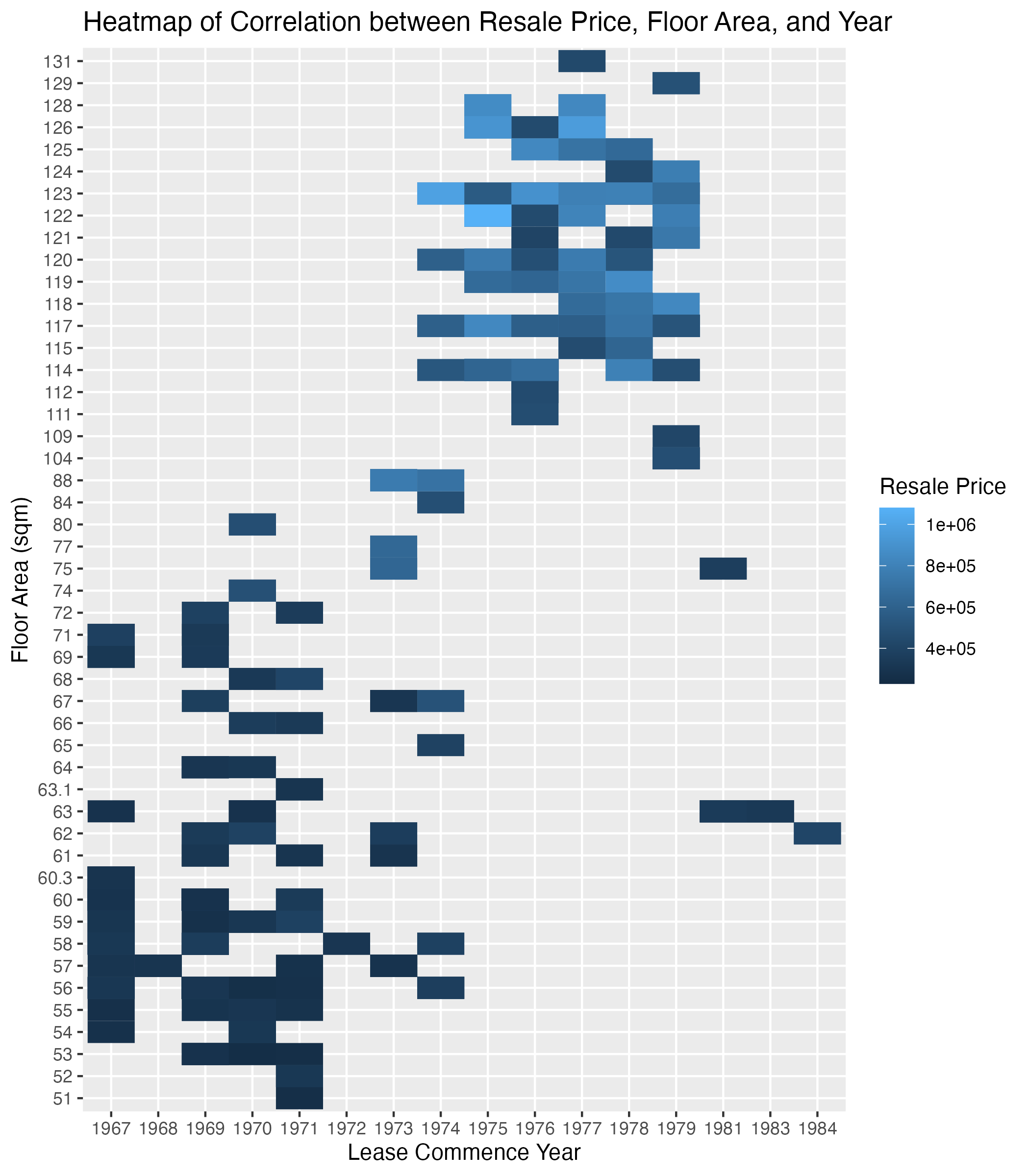
Pattern Observation
We can see when taking lease commence year and floor area, generally the newer the flat (later lease commence year) and bigger the size (bigger floor area), the higher the resale price (lighter in blue color tone). However there are also some outliers.
Hence it is really not enough to look at one aspect of the HDB property to predict the price, all these factors: town, flat type, floor area sqm, flat model and lease commence date/ remaining lease, play a part in influencing the resale price.
The above concludes my Take Home Exercise 3.
Thank you for reading!